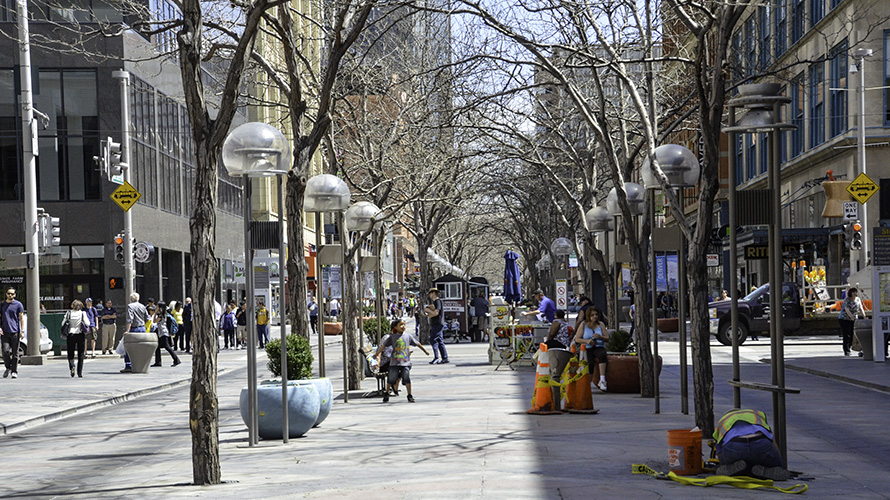
Denver, Colorado
I will start this series of blogs on geography’s core concepts by identifying the ones I have selected to write about. Different national curriculums have different lists, but they mostly agree on four fundamental ones — place, space, environment and interconnection. They are central to geographical thinking and are the subject’s biggest ideas, because:
- They are each at the top of a hierarchy of concepts of increasing complexity and abstractness, as they incorporate subordinate simpler and less abstract concepts, but cannot be subsumed by an even bigger and more abstract one. Place, for example, incorporates the concept of region; environment incorporates nature and landscape; and interconnection incorporates systems.
- They can be applied to a great variety of topics and across different fields of the subject, and so give geography a degree of unity and coherence.
- They have a number of functions, such as identifying topics worth studying and questions to ask, organising information, suggesting methods of analysis, forming generalisations, identifying possible explanations, and providing a basis for public policies.
These characteristics will be explained in subsequent blogs.
Although the four concepts are also found in other disciplines, such as ecology, archaeology, epidemiology, economics and sociology, in none are they as central to thinking and practice as in geography, and in none are they as frequently used in combination. Furthermore, when applied in another discipline their meaning may not be identical to that in geography. Space, for example, is sometimes used in other social sciences to mean the same as the way place is described in a later blog. As used in geography, they are what makes the subject ‘geographical’, and they enable students to distinguish what is distinctively different about learning geography from other school subject areas (Brooks, 2018, p. 106).
Time or change, scale and sustainability are other common core concepts in school geography curriculums. However, they differ from the first four in their more limited range of functions. Scale, for example, is largely an analytical concept, because it is mostly used in geography to analyse relationships by investigating them at different scales, or across scales. Time is also an analytical concept, because it can be used to explain phenomena by understanding how they have developed or changed over time. Sustainability, on the other hand, is largely an evaluative concept, because it is mostly used to assess the implications of an environmental change, or the economic or demographic viability of a place.
So in these blogs I will talk about place, space, environment, interconnection, time, scale and sustainability. I will also have a blog on the case for human wellbeing as a core concept in geography.
Reference
Brooks, C. (2018). Understanding conceptual development in school geography. In M. Jones & D. Lambert (Eds.), Debates in geography education (2nd ed., pp. 103–114). Routledge.
Homepage: Geography’s core concepts: a teacher’s guide
Next blog: Blog 2: Unpacking geography’s core concepts
 Geography's core concepts