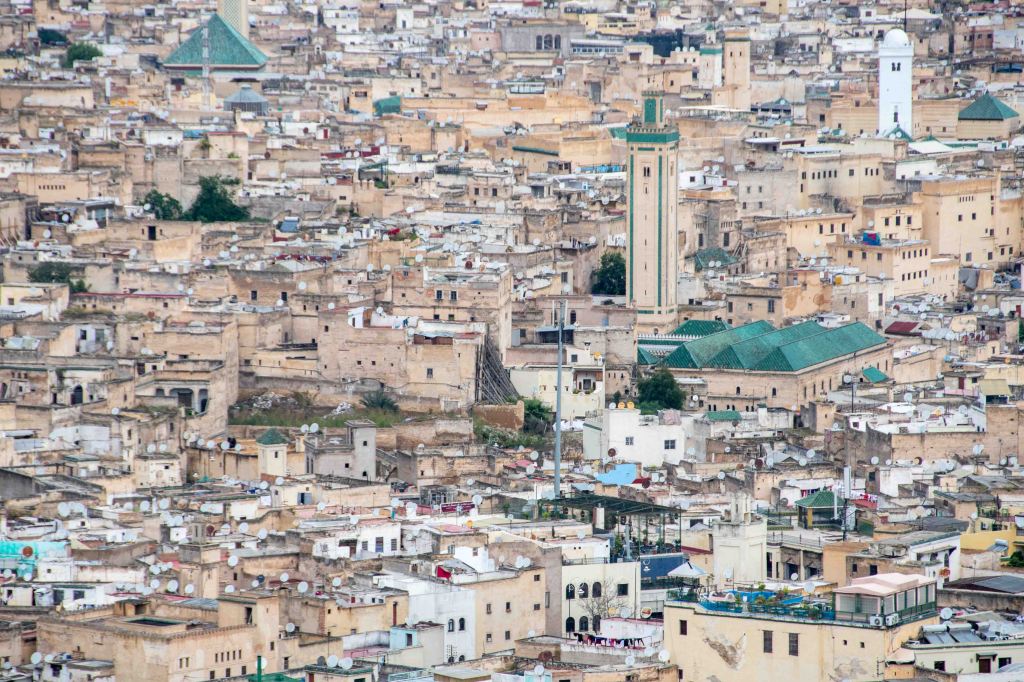
The Medina, Fes, Morocco
To understand them it is first essential to recognise that they are ideas that we think with, not objects that we study. For example, while places are parts of the Earth’s surface that have been defined, named and given meaning by people, the concept of place is about ways of thinking that are based on the significance and influence of places. Similarly, the concept of environment is not about the study of the biophysical environment, but about how we conceptualise and understand it, and its significance to humans. It is a way of seeing the world that highlights the importance of the environment for human and other life, its influence on people and societies, and the impacts on it of human actions.
Second, they are not substantive concepts like ‘city’ or ‘climate’, which are about the substance of geography, but are meta-concepts, or concepts about concepts, similar to ‘big ideas’ in science education. Consequently they are difficult to define in a single sentence because they encapsulate a number of smaller ideas. The concept of space, for example, includes at least eleven different subsidiary concepts — absolute location, relative location, distance, time-space convergence, accessibility, centrality, proximity, remoteness, spatial distribution, spatial diffusion, and the organisation of space. It is a simple word, but covers many ideas, and all of these need to be understood before a student can adequately comprehend the meaning of space in geography.
Geography’s core concepts sit at the top of a hierarchy of smaller ones, and student understanding of them is best developed by generalising upwards, from the concepts at the bottom of a hierarchy towards increasingly abstract syntheses of geographical knowledge at the top. This is an example:
1. Temperature, precipitation, sunshine and wind are combined in the concept of weather.
2. The concept of a season describes the average weather for particular periods of the year.
3. The concept of climate is about the average weather, with its seasonal variations, experienced by a place over a long period of time.
4. Climate is a major, but not the only, influence on other elements of the biophysical environment, such as vegetation, soils, water resources and agriculture. This environment, in turn, has an influence on human societies, but this is mediated by culture, technology and institutions, has weakened over time, and is contested. The concept involved here is that of environment-human relationships, part of the concept of environment and a central theme in geography.
A way of thinking about place, space, environment and interconnection in geography is to regard them as words that remind you of many geographical ideas. The word environment, for example, reminds one to think about the effects of human actions on the biophysical environment, while the word space reminds one to think of the influence of distance on human activities. They are simple words that contain a multitude of ideas.
Homepage: Geography’s core concepts: a teacher’s guide
Next blog: Blog 3: The functions of geography’s core concepts
 Geography's core concepts