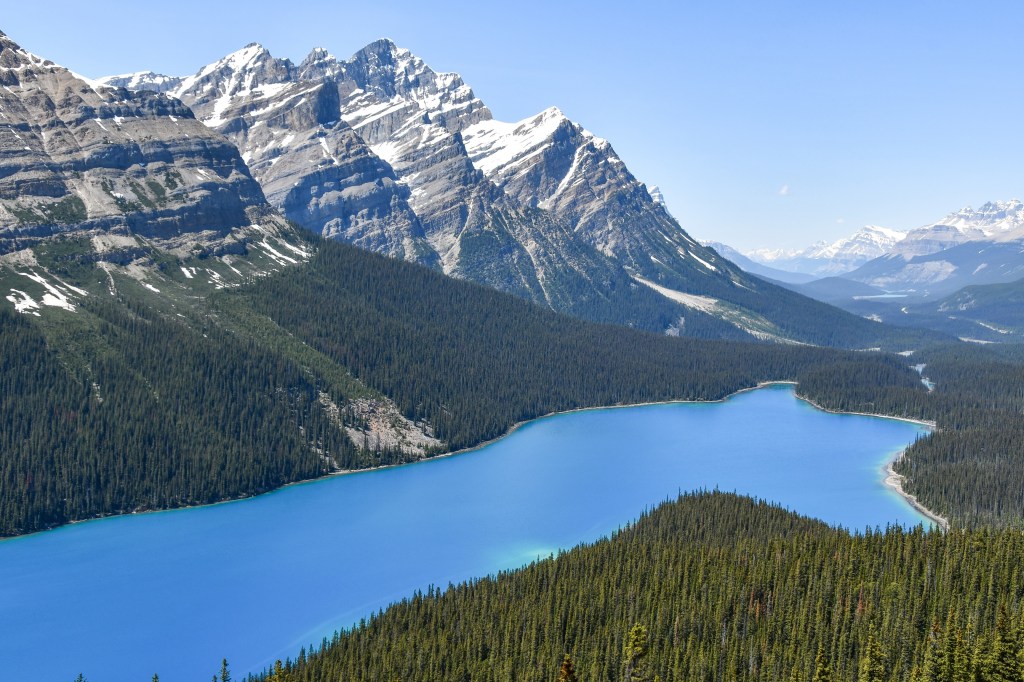
Peyto Lake, Rocky Mountains, Canada
Geography’s core concepts influence the practice of geography in a number of ways, from how geographers perceive the world to the design of public policies, and students should understand that they are not just big ideas, but have functions that enable them to do geography as well as to think about it. Some of the ways the core concepts are used in geography are briefly described below.
Ways of perceiving the world
Geography’s key concepts provide distinctive ways of viewing and investigating the world. For example, the processes and patterns of socioeconomic change as nations develop will be perceived differently by different disciplines. An economist is likely to focus on changes in the structure of the economy, a political scientist on changes in political institutions, and a sociologist on changes in class structures, personal beliefs, or gender relations. A geographer, on the other hand, is likely to study the causes and consequences of the spatial changes that both result from and contribute to national
socioeconomic change, such as urbanisation, internal and international migration, and the development of new economic regions and cities. In the study of health, a medical scientist might focus on the effects of individual characteristics such as age, sex, and occupation on health outcomes, while a geographer might study the effects of the physical and social environment of the place in which people live (a place-based perspective), or of accessibility to health services (a spatial perspective), on their health. The ways of thinking of different disciplines consequently influence how they perceive and study the same phenomena.
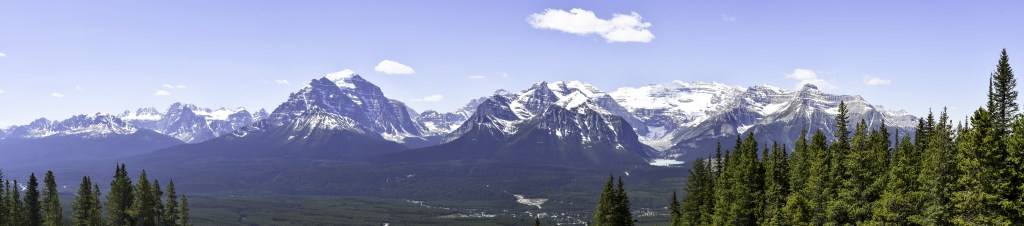
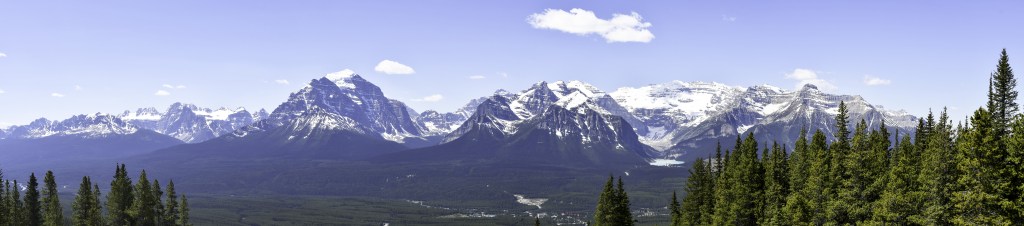
Canadian Rocky Mountains panorama
Questioning
Distinctively geographical questions are derived from the subject’s concepts. If students are studying a place, they might use the concept of space to ask the question ‘are the characteristics of this place influenced by its relative location’, while the concept of interconnection leads to the question ‘are the characteristics of this place influenced by its relationships with other places’, and the concept of environment prompts the question ‘are the characteristics of this place influenced by its biophysical environment’.
Organising and analysing data
Before data can be analysed it has to be organised in some way, and some of these options are
geographical. For example, data that is recorded and portrayed by place, such as by settlements, local government areas or environmental zones, applies the concept of place, while data that is mapped applies the concept of space. These are two very common ways of organising and portraying data in geography, and both are based on a key geographical concept.
Analysis means examining a complex topic by breaking it into its component parts, studying each of them separately, and then putting them together again to identify their relationships. This applies the concept of interconnection. Another type of analysis is to identify the essential features of something, such as the pattern in a map, which applies the concept of space.
Generalising
Generalisations produced from the study of individual cases or topics help students to consolidate and integrate their understanding. Geographical generalisations are based on the discipline’s concepts, as in this example:
The first part of this statement contains an explanation for the
clustering of economic activities, while the last part identifies exceptions to the generalisation. Explanatory generalisations like these are powerful because they enable students to transfer their understanding to new contexts, and to answer questions and solve problems that are new to them.
Comparison is also an analytical method when used to understand causal relationships. In geography it typically involves a comparison between places, and therefore applies the concept of place, or a comparison of spatial distributions, which applies the concept of space.
Explaining
The explanations used in geography range across the natural and social sciences, and for some topics could also include ideas from the humanities. This does not make them ‘geographical explanations’, because they are not derived from a key geographical concept. A geographical explanation might relate to the distinctive characteristics of a place (concept of place), relative location (concept of space), or the influence of the environment (concept of environment). Yet even these explanations are likely to be multi-disciplinary. The influence of
relative location on businesses, for example, is through the costs and time involved in overcoming distance. Similarly, distance affects migration decisions through the psychological and economic costs of moving, and not just through physical distance, while the environment influences farming through the relative profitability of alternative crops, mediated by the culture and knowledge of the farmer. This wide-ranging way of explaining is one of the strengths of geography, because it produces a comprehensive analysis of causes and consequences, and not one limited to the perspective of a single discipline
Responding
Responding requires students to use their knowledge to think of ways to respond to a problem they have identified. To do this effectively they must have a good understanding of the causes of the problem, think of strategies that will counter these causes, and explain how any strategy will make a difference. Strategies to address environmental, economic and social issues often have a basis in one of geography’s key concepts, although this may be implicit rather than explicit. For example, local and regional economic and social
development strategies that address the unique problems and resources of a place are implicitly based on the concept of place. Similarly, the creation of vegetation corridors to link conservation areas illustrates the concept of interconnection, while strategies to develop isolated places by improving their transportation and communications connections with major centres, and consequently reducing the costs imposed by distance, illustrate the concept of space. This function of the key concepts is often missing from school geography.
Maude, A. (2024). Thinking geographically, Routledge, chapter 2.
Homepage: Geography’s core concepts: a teacher’s guide
Next blog: Blog 4: The concept of place
 Geography's core concepts