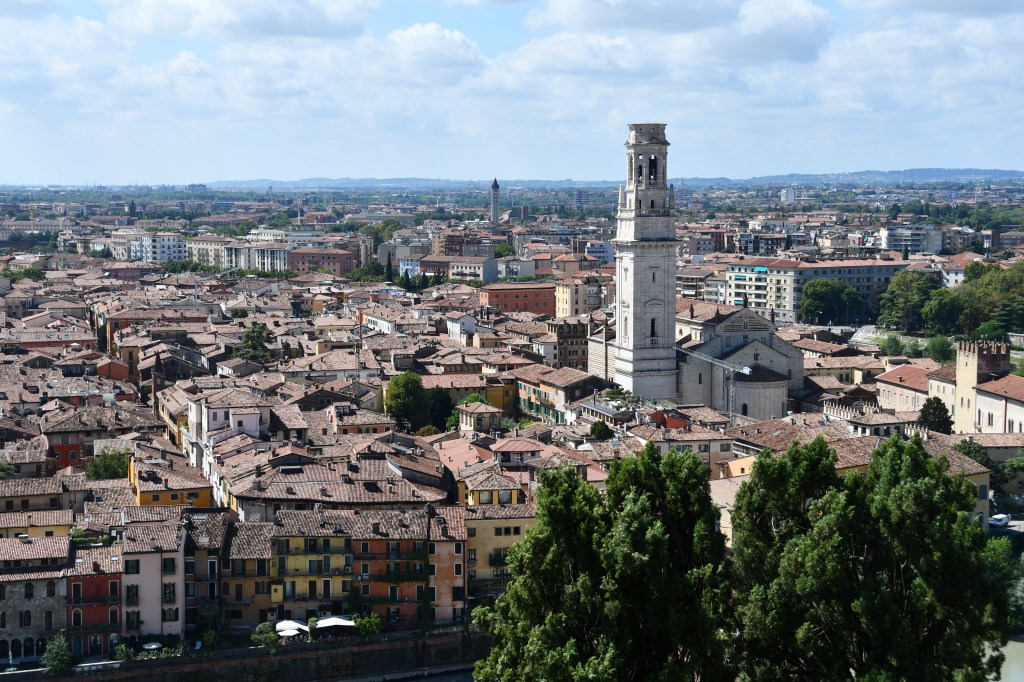
Verona, Italy
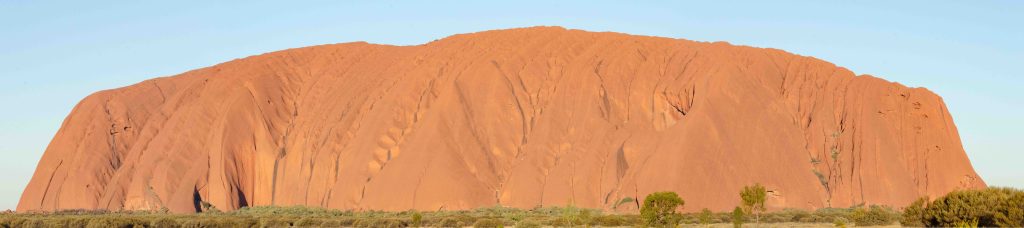
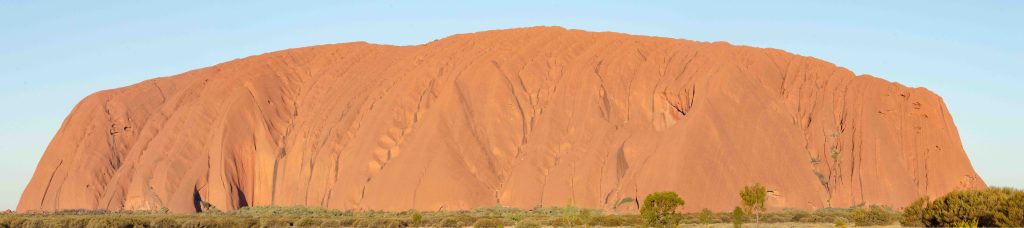
Uluru, Central Australia
What is a place?
What is a place, and how can it be defined? Tim Creswell (2014, p. 4) writes that Place is best known to geographers as a meaningful segment of space. This means that it is an area of the Earth’s surface, a space, that has been identified and named by people. A place has the following characteristics:
- A location.
- A spatial extent, but this may be quite fuzzy and undefined, and places merge into each other. Many do not have clear boundaries, but they are still bounded and not limitless.
- A name, identity and meanings for individuals and social groups. These identities and meanings are created by people and are social constructions, and consequently the names, identities and spatial extent of places can change over time.
Places identified by these criteria range in size from a room to a home, a suburb, town or city, region, nation and even the whole planet, because these are all spaces
that have been identified and given meaning by people. However, the places of interest to geographers, and studied in schools, are likely to be in the middle of this range, such as suburbs, towns, cities and regions. Studies of countries may also be thought of as being about places.
In physical geography place has a somewhat different meaning to that described above, but still similar in some important ways. Places in physical geography are areas at all scales that are identified as having some common characteristics. For a study of a river, places might range from an erosional or depositional landform (a geomorphic unit), to a section of the river with an assemblage of landforms (a reach), to a complete river basin. For vegetation, places could be defined as areas of distinctive plant communities and their edaphic, geomorphic and climatic environments. These are not places identified by their meanings to people, and they may not be named, but they are places with unique environmental characteristics, and these have an influence on environmental processes.
Attachment to place
People develop attachments to particular places by living in and becoming familiar with them, and this place attachment is significant in that it contributes to a person’s identity and sense of belonging.
Place attachment is likely to be strong when a person’s close relationships are with people in the same place, and where they belong to a strongly functioning local community. Place attachment is also likely to be strong amongst people who do not move far from their place of origin, which is the case with the vast majority of the world’s population in both high- and low-income countries. It is especially strong amongst many Indigenous communities, even when they have been displaced or moved away from their original home place. However, surveys that find that around 4 in 5 Australian adults feel a sense of belonging in their neighbourhood suggest that a degree of place attachment is quite common.
On the other hand, place attachment has often been thought to have declined for the growing number of mobile people. Yet research suggests that this may not be the case, because mobile people develop attachments to new places without necessarily losing their attachment to their place of origin, and can become engaged with many places. Place attachment is not incompatible with mobility.
Not all feelings about places are positive. Home, for example, may be a safe haven, or a place of danger for women and children. Neighbourhoods may be threatening to minority groups, and towns may be hostile to people who do not share the dominant values and do not ‘fit in’. Place attachment can also be negative. Inward-looking communities, with strong place attachment, can be stifling, hide bound in tradition, inbred, and, especially for the young, boring, and dull. It is not surprising that getting out of a place is a recurrent theme in popular music and movies (Relph, 2017, p. 182).
Indigenous concepts of place
Indigenous concepts of place are different to those described above, and can be illustrated from Australian Aboriginal culture. In Aboriginal Australian English the term Country refers to an area or place known to be associated with and belonging to a group of people linked by kinship, although because of dispossession and migration they may no longer live there. Country is therefore a type of place. In other Indigenous cultures the equivalent English term may be Land. Country is eloquently described by Ambelin Kwaymullina, an Aboriginal lawyer and writer, in this passage:
For Aboriginal peoples, country is much more than a place. Rock, tree, river, hill, animal, human—all were formed of the same substance by the Ancestors who continue to live in land, water, sky. Country is filled with relations speaking language and following Law, no matter whether the shape of that relation is human, rock, crow, wattle. Country is loved, needed, and cared for, and country loves, needs, and cares for her peoples in turn. Country is family, culture, identity. Country is self. (Kwaymullina, 2005, p. 12)
For Aboriginal Australians the concept of Country as a place has these characteristics:
- Country was created and given meaning by Ancestral Beings whose knowledge is passed on between generations.
- A Country is small enough to accommodate face-to-face groups of people, and large enough to provide the resources to sustain them.
- Country contains the stories, songlines and sacred sites that preserve the knowledge and laws of the community, so Country is a teacher.
- Country is a living whole. Weather, land, sea, plants, animals and people are all interconnected and interrelated, both practically and spiritually. There is no concept of nature and culture as separate.
- Country is aware, and can communicate. Non-Indigenous students may find this difficult to understand, but the concept could be illustrated by examples. These include birds that warn people of danger, fireflies that tell when goose eggs and crocodile eggs are ready to harvest, flowers that tell when to harvest a plant, and birds that call when the tide is coming in, People must also be open to what Country is telling them, for example, that it is sick and that degraded areas need attention, or the appropriate ceremonies are needed to restore its health.
- The health of Country and people are interdependent.
This is a very rich concept of place, and of relationships between places and humans. It is also a way of thinking that produces strong place attachment, and strong political movements to maintain or restore Indigenous people’s rights to their historic territories. Indigenous concepts of place such as these remind us not to assume that Western geographical ways of thinking are universal.
Place and public policy
Place is not just an academic idea. It is also the framework for a wide range of policies and initiatives designed to improve social, economic and environmental conditions by recognising the uniqueness of individual places. Most national economic and social policies are spatially blind in that they do not vary from place to place or target particular places. Place-based policies, on the other hand, target the specific circumstances of a place and engage the community and a broad range of local organisations from different sectors as active participants in their development and implementation (Government of Victoria, 2020).
Their distinctive features are that they are tailored to the needs and potential of each place, and depend on local leadership and local involvement. They address a wide range of issues, such as educational quality and school attendance, health, disengaged youth, crime, employment, environmental quality and infrastructure, and the areas they cover range in size from a group of suburbs to a local government area to a large region. For an example of an argument for a place-based approach to policies to reduce regional economic inequalities see chapter 11 in Maude (2024).
References
Creswell, T. (2014). Place. In R. Lee, N. Castree, R. Kitchin, V. Lawson, A. Paasi, C. Philo, S. Radcliffe, S. M. Roberts & C. W. J. Withers (Eds.), The SAGE handbook of human geography, vol. 1. SAGE.
Government of Victoria, Department of Premier and Cabinet (2020). A framework for place-based approaches..
Kwaymullina, A. (2005). Seeing the light: Aboriginal law, learning and sustainable living in country. Indigenous Law Bulletin, 6(11), 12–15.
Relph, E. (2017). Place and connection. In J. Malpas (Ed.), The intelligence of place: Topographies and poetics (pp. 177–204). Bloomsbury.
Further reading
Beer, A., McKenzie, F., Blažek, J., Sotarauta, M., & Ayres, S. (2020). Every place matters: Towards effective place-based policy. Taylor & Francis.
Maude, A, (2024). Thinking geographically, Routledge, chapter 4.
Homepage: Geography’s core concepts: a teacher’s guide
Next blog: Blog 5: The influence of place
 Geography's core concepts